
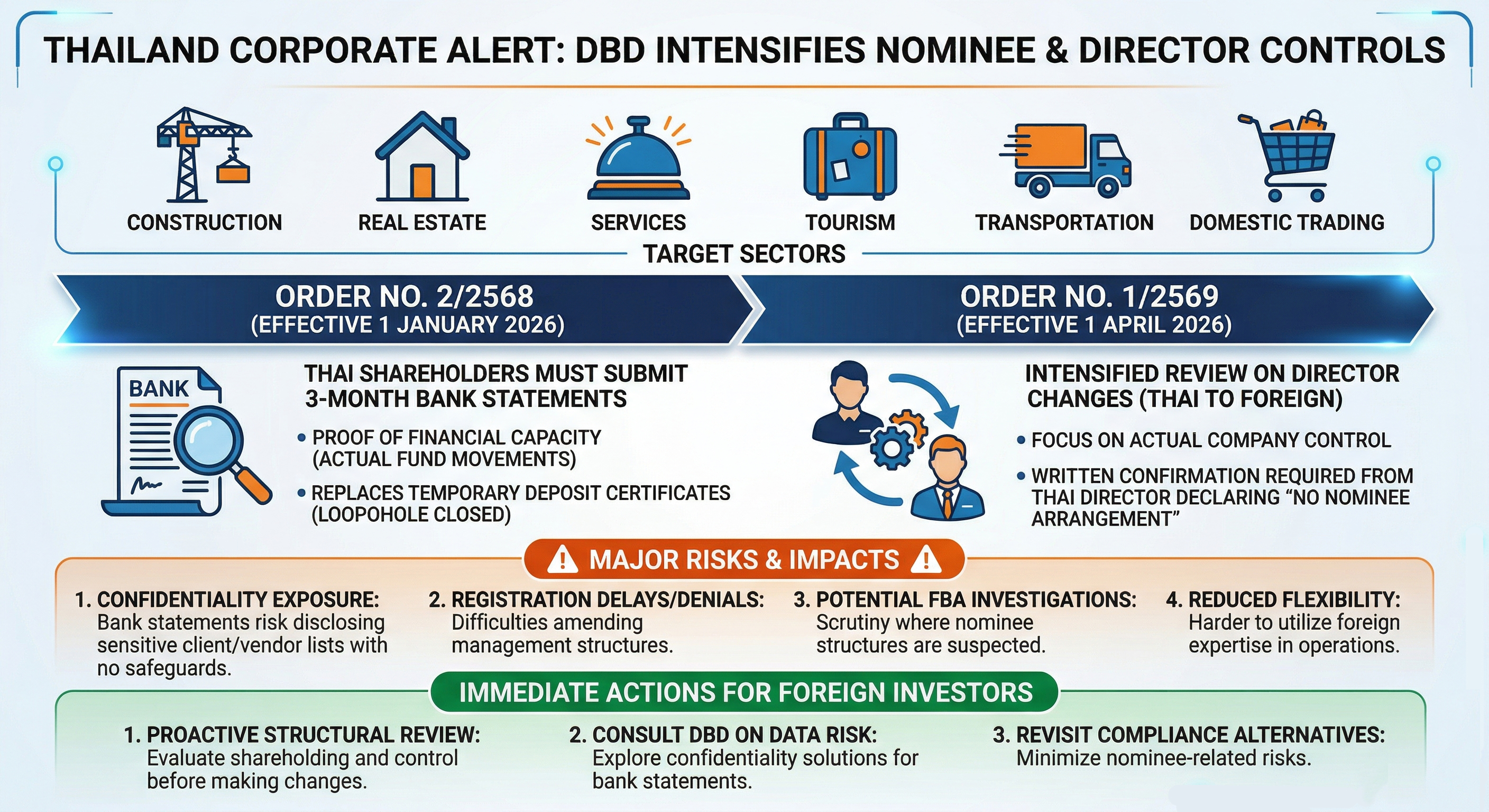
The tightening of the regulatory approach by the Department of Business Development (DBD) significantly increases both compliance risk and practical constraints for companies whose structures fall within the regulatory scrutiny.
The DBD has intensified its review of nominee arrangements as part of a broader regulatory oversight, reflecting ongoing concerns over the increasing use of nominee structures, particularly in construction, real estate, services, tourism, transportation, and domestic trading activities.
Its initial measure, Order No. 2/2568 (effective 1 January 2026) requires Thai shareholders to submit evidences that demonstrating their financial capacity (i.e., actual fund movements) in the form of 3 month bank statements, replacing the previous bank balance certificates with a loophole that funds could be deposited temporarily for registration purposes. Then, Order No. 1/2569 (effective 1 April 2026) further increases regulatory review focusing on changes of authorized directors (from Thais to foreigners) and actual control of companies.
Regulatory Impact
Companies seeking to invest in Thailand with foreign shareholding below 50%, or with wholly Thai shareholding but foreign authorized directors, often for legitimate commercial reasons, such as the foreign director’s expertise or operational oversight, now face requirements that may be difficult to satisfy in practice. In particular, the requirement for Thai shareholders to submit 3-month bank statements may raise internal constraints, as such statements can contain commercially sensitive or confidential information (such as vendor lists, client details, or transaction counterparties). Disclosure of this information may raise commercial and counterpart-related risks for Thai shareholders, particularly where they are juristic persons. This concern is heightened by the absence of any mitigation measures or confidentiality safeguards, as such information may be published and readily accessible to the public.
While the company’s structure may have been compliant with the Foreign Business Act (“FBA”) when it was originally established, it is now subjected to renewed regulatory scrutiny. Under Order No. 1/2569, changes in authorized directors, particularly where a company previously had only Thai authorized directors and subsequently appointed a foreigner, would trigger additional regulatory review. In such cases, the Thai director must submit a written confirmation declaring that the investment structure is genuine and that no nominee arrangement exists. As a result, any attempt by a company to amend its management structure that falls within the scope of scrutiny under the order may expose the company to regulatory risk, including
• delays or inability to register changes to authorized directors,
• potential investigation under the FBA where nominee arrangements are suspected, and
• increased compliance burdens and reduced flexibility in restructuring management to allow foreign personnel to participate in operations.
Overall, the new enforcement measures make it more challenging for foreign-invested businesses to adjust their management or control arrangements, even for legitimate commercial reasons.
What Foreign Investors Must Do Right Away:
Regarding the increased scrutiny and the absence of formal confidentiality safeguards at the DBD, companies may take initiative in consulting with the DBD to explore practical solutions for managing confidentiality risks associated with the disclosure of 3-month bank statements. Companies are also encouraged to proactively review their shareholding and control structures before implementing any changes involving foreign directors, while revisiting alternative options to avoid nominee related risks.
About Author:
Mrs. Opor Dharmaroj, Partner at DRKI, leads corporate and commercial practice. She advises foreign investors and Thai companies on navigating Thailand’s evolving corporate registration and nominee-related requirements. Her work emphasizes practical, forward-looking guidance on ownership and director structures, regulatory filings, and compliance planning, helping clients understand their regulatory position and implement changes with confidence.
[Contact Person: Mrs. Opor Dharmaroj, Partner]